
Liquid Cooling in Latin America: From Emerging Technology to Commercial Reality
Liquid cooling is moving from a specialized technology to a strategic consideration for high-density data center infrastructure in Latin America.
Original analysisEditorial teamPublished 19 Oct 2026
7 min read
Executive Summary
Liquid cooling is moving from a specialized technology to a strategic consideration for high-density data center infrastructure in Latin America.
The expansion of artificial intelligence, accelerated computing, and increasingly powerful server architectures is changing how data centers must be designed, cooled, and operated.
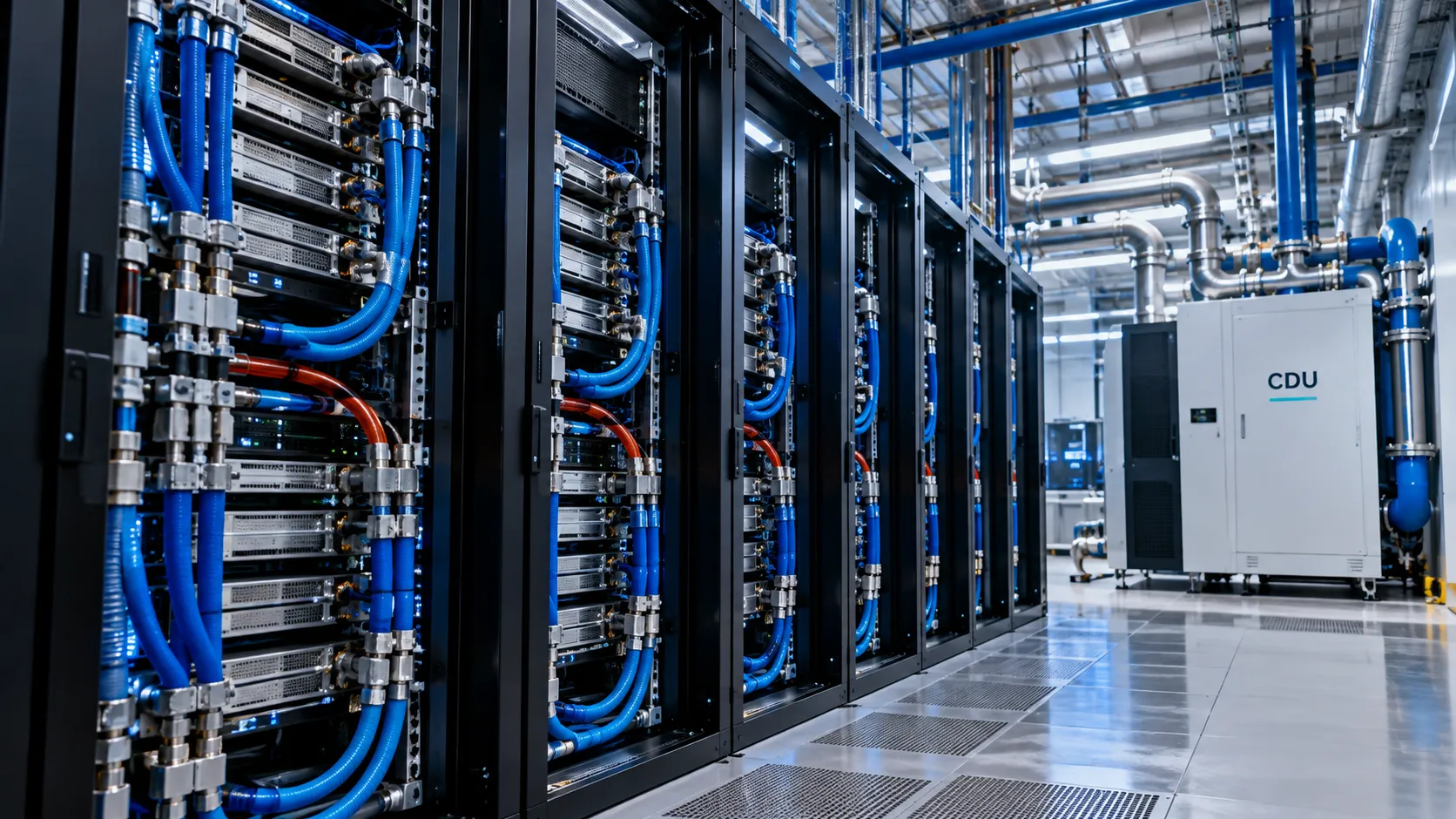
However, the transition is not simply about replacing air cooling with liquid cooling. It requires a broader transformation of thermal infrastructure, including coolant distribution units (CDUs), hydraulic networks, heat rejection systems, controls, redundancy, and operational expertise.
For Latin America, the central question is no longer whether liquid cooling will become relevant. It is how quickly operators, engineering firms, and infrastructure providers can prepare for its deployment.
1. AI Is Changing the Thermal Requirements of Data Centers
Traditional enterprise data centers have relied primarily on air-based cooling systems, including computer room air conditioners (CRACs), computer room air handlers (CRAHs), and chilled-water infrastructure.
These technologies remain essential and will continue to serve a substantial portion of the market.
However, AI computing introduces different thermal challenges.
High-performance GPUs and tightly integrated computing architectures concentrate substantial processing power within individual racks. As equipment density increases, transferring heat efficiently from critical components becomes more demanding.
NVIDIA's GB200 NVL72 architecture illustrates this shift. It integrates 72 Blackwell GPUs and 36 Grace CPUs into a liquid-cooled, rack-scale computing system.
Such architectures demonstrate why thermal management is increasingly part of the computing platform itself rather than merely a supporting building service.
The implication is significant: cooling infrastructure must be considered earlier in the data center design process, alongside electrical capacity, IT architecture, networking, and operational resilience.
2. Latin America Is Entering the Deployment Phase
One of the clearest regional developments occurred in September 2026, when ODATA, an Aligned Data Centers company, announced the deployment of DeltaFlow liquid cooling technology at two campuses:
- SP04 in Brazil.
- QR03 in Querétaro, Mexico.
According to the company, the first phase of installation and testing is supported by a combined investment of approximately US$630 million.
The DeltaFlow solution was developed by Aligned in collaboration with Munters to support high-density computing environments.
This announcement is important because it demonstrates that liquid cooling is no longer confined to international technology demonstrations. It is becoming part of real infrastructure deployment plans within Latin America.
Nevertheless, announced investments and installations should not be interpreted as evidence that the entire regional market has already transitioned to liquid cooling.
Adoption will vary according to customer requirements, IT deployment schedules, existing infrastructure, capital investment, and local engineering capabilities.
3. Why Liquid Cooling Is More Than a CDU
A common misconception is that adopting liquid cooling primarily involves selecting a coolant distribution unit.
In reality, a CDU is only one component of a complete thermal architecture.
A typical direct-to-chip liquid cooling deployment may involve several interconnected systems:
- IT cooling circuit
- Cold plates, rack manifolds, hoses, quick-disconnect connections, and the technology cooling system serving the computing equipment.
- Coolant distribution
- CDUs, pumps, heat exchangers, instrumentation, filtration, and control systems.
- Facility water infrastructure
- Piping networks, distribution headers, expansion arrangements, water treatment, and thermal interfaces.
- Heat rejection
- Chillers, dry coolers, cooling towers, hybrid systems, or other heat rejection technologies selected according to design conditions.
- Monitoring and protection
- Temperature and pressure monitoring, flow measurement, leak detection, alarms, redundancy, and building management system integration.
The design challenge is not simply achieving the required cooling capacity. It is ensuring that these subsystems operate together reliably under both normal and abnormal conditions.
This is particularly relevant when multiple vendors are responsible for different portions of the infrastructure.
4. Engineering Considerations for LATAM Deployments
Latin America presents a diverse combination of climate conditions, infrastructure maturity, electrical constraints, and operational requirements.
Consequently, liquid cooling systems should not be specified using a single regional design assumption.
Cooling-water temperatures
Supply-water temperatures influence the selection of heat rejection equipment and the potential for economizer operation.
ASHRAE's liquid-cooling guidance provides temperature-based classes to help engineers understand equipment and facility operating requirements.
Higher permissible cooling-water temperatures may expand opportunities for reduced mechanical refrigeration, depending on local weather conditions and the equipment's approved operating envelope.
However, the possibility of operating without chillers must be evaluated through site-specific engineering analysis.
Hydraulic performance
Thermal capacity alone is insufficient to select a CDU.
Engineers must evaluate coolant flow, pressure differential, allowable operating pressure, fluid properties, and the pressure losses associated with piping, manifolds, and IT equipment.
For a single-phase liquid circuit, the fundamental thermal relationship is:
Q = ṁ · cp · ΔT
Where:
- Q is the heat-transfer rate.
- ṁ is the coolant mass-flow rate.
- cp is the fluid's specific heat capacity.
- ΔT is the temperature difference between inlet and outlet.
For volumetric-flow calculations, fluid density must also be considered.
These relationships provide the foundation for preliminary sizing, but detailed equipment selection requires verified manufacturer performance data.
Fluid compatibility and water quality
Cooling fluids must be compatible with the materials, seals, heat exchangers, pumps, and cold plates used throughout the system.
Water quality, corrosion protection, filtration, and fluid maintenance are therefore critical design and operational considerations.
Redundancy and serviceability
Liquid cooling introduces additional operational dependencies.
Pump failures, control malfunctions, insufficient flow, fluid contamination, and leakage can affect equipment availability.
Appropriate redundancy, monitoring, isolation, maintenance access, and failure-response procedures must be established according to the reliability objectives of the facility.
5. Air Cooling and Liquid Cooling Will Coexist
The development of liquid cooling does not mean that air cooling is becoming obsolete.
Many data centers will continue using air-based systems for conventional workloads, lower-density racks, and the residual heat not captured by liquid cooling.
Hybrid architectures combining direct-to-chip cooling with air cooling are therefore likely to remain important.
This coexistence creates an engineering requirement to coordinate both systems.
For example, liquid cooling may remove a substantial portion of the heat generated by processors, while fans, power supplies, memory, networking equipment, and other components continue releasing heat into the surrounding environment.
The remaining air-side thermal load must still be addressed.
For operators and engineering companies, the relevant question is not necessarily which technology will replace the other, but how to optimize the complete cooling architecture for each workload.
6. Commercial Opportunities Across the Region
The transition toward high-density computing creates opportunities extending well beyond CDU manufacturing.
Potential areas of demand include:
- Engineering studies and liquid-cooling readiness assessments.
- Hydraulic infrastructure and distribution systems.
- CDU integration and commissioning.
- Chillers, dry coolers, and heat rejection equipment.
- Cooling-system monitoring and controls.
- Water treatment, filtration, and fluid management.
- Technical maintenance and local service capabilities.
- Retrofit projects for existing data centers.
Mexico and Brazil provide visible examples of liquid-cooling infrastructure activity, while other Latin American markets may develop at different speeds.
For technology suppliers and engineering firms, local execution capability could become an important competitive differentiator.
International equipment availability alone does not guarantee successful deployment. Operators also require qualified engineering support, installation, commissioning, spare parts, and reliable long-term maintenance.
These requirements create potential opportunities for regional partnerships among equipment manufacturers, mechanical contractors, integrators, and specialized service providers.
7. The Next Competitive Advantage: Thermal Infrastructure Readiness
As AI computing continues to evolve, the ability to accommodate future thermal loads may become an important consideration in data center development.
Facilities designed with sufficient hydraulic distribution space, adaptable mechanical systems, appropriate monitoring, and expansion capacity may be better positioned to integrate high-density technologies.
However, investing in liquid-cooling infrastructure before demand is confirmed also carries financial and operational risks.
The most effective strategy is therefore not necessarily immediate full deployment.
For many operators, a phased approach may be more appropriate:
- Assess anticipated IT workloads and rack densities.
- Evaluate existing thermal infrastructure and retrofit constraints.
- Establish a liquid-cooling-ready mechanical architecture.
- Validate the selected technology through engineering and commissioning.
- Expand capacity in line with confirmed computing requirements.
This approach connects technical preparation with commercial discipline.
Conclusion: A New Chapter for Thermal Engineering in Latin America
Liquid cooling is becoming an increasingly important element of the region's digital infrastructure strategy.
The emergence of real deployments in Brazil and Mexico, together with the evolution of high-density AI computing, indicates that the market is moving beyond theoretical discussions.
Yet the long-term success of liquid cooling in Latin America will depend on more than technology adoption.
It will require integrated thermal engineering, reliable hydraulic infrastructure, qualified local partners, operational expertise, and careful alignment between computing requirements and infrastructure investment.
The next generation of data centers will not be defined by cooling equipment alone, but by how effectively computing, energy, and thermal infrastructure operate as one integrated system.
Editorial note: This article combines publicly documented industry developments with independent engineering and market analysis. Commercial opportunities and future market developments are analytical interpretations, not confirmed procurement forecasts.
Sources
- ODATA Brings Next-Generation Cooling to Latin America with DeltaFlow Liquid Cooling Technology (17 Sep 2026) — ODATA / Aligned Data Centers, Link checked 19 Oct 2026
- GB200 NVL72 — Rack-Scale AI Computing Architecture — NVIDIA, Link checked 19 Oct 2026
- AI Data Center Energy Performance Framework — Introduction and Purpose — ASHRAE, Link checked 19 Oct 2026
- Direct Liquid Cooling Adoption Remains Slow and Steady (Jul 2025) — Uptime Institute, Link checked 19 Oct 2026
Editorial analysis; not engineering advice. Verify against original sources.
Get the Weekly Cooling Brief
Mission-critical cooling for digital infrastructure. Optional, one short email a week, unsubscribe anytime.
Edge & Telecom Cooling · Enterprise & Colocation Data Centers · Hyperscale Cooling · AI & High-Density Liquid Cooling · Modular & Distributed Data Centers · LATAM Market Intelligence